Veterinary Clinic Hazard Communication & SDS Binder
Veterinary Clinic Hazard Communication & SDS Binder is an 89-page, 8.5 x 11 inch paperback workbook of fill-in forms for keeping a veterinary clinic’s OSHA Hazard Communication (29 CFR 1910.1200) records on paper: a written HazCom program template, chemical inventory pages, an SDS index and revision log, label templates, employee training records and annual review checklists. It costs $29.99 on Amazon (ASIN B0HNR746RZ).
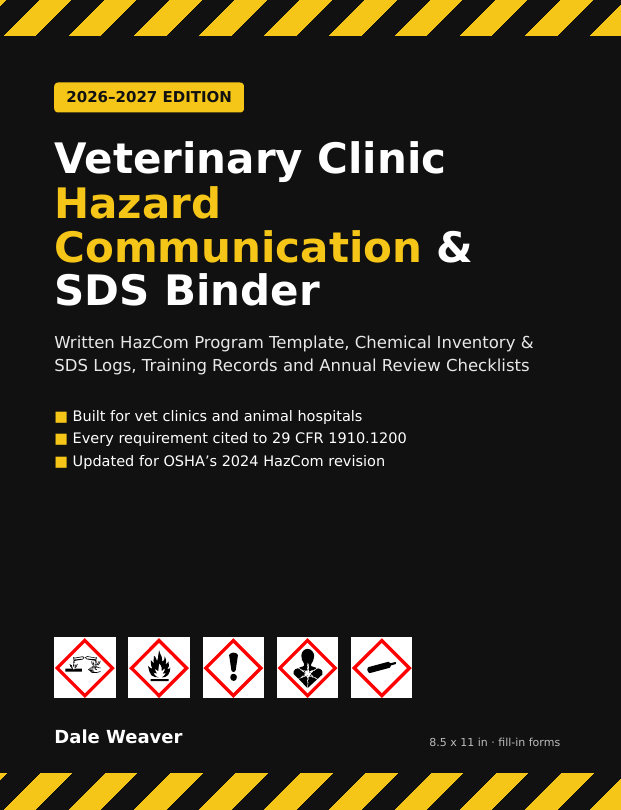
| Format | Paperback, 8.5 x 11 in, black-and-white interior |
|---|---|
| Pages | 89 |
| Price | $29.99 on Amazon.com |
| Author | Dale Weaver |
| Published | October 18, 2026 (independently published) |
| ISBN-13 | 979-8-163500192 |
| ASIN | B0HNR746RZ |
What’s inside
- pp. 4–7 · HazCom in a veterinary clinic. The five employer requirements, what “readily accessible” means in a clinic, product categories that need extra attention (anesthetic agents such as isoflurane and sevoflurane, formalin, cold sterilants, disinfectant concentrates, compressed gases, drugs staff prepare), why strength and form matter, what usually does not need an SDS, when training is due, and what the 2024 revision changed.
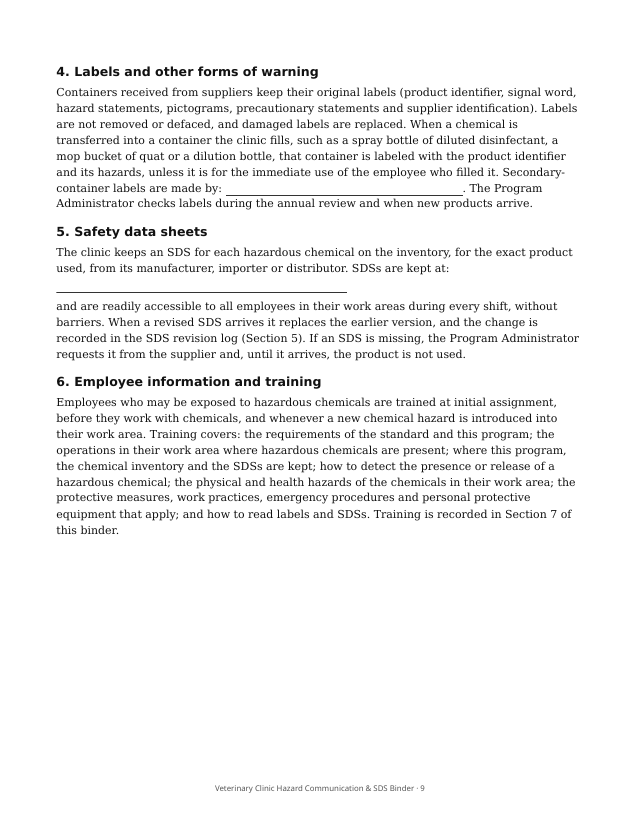
- pp. 8–11 · Written Hazard Communication Program (fill-in). Nine parts: purpose and policy, program administrator, chemical inventory, labels, safety data sheets, training, non-routine tasks, contractors, availability and review; plus clinic-specific notes and a review-and-update record.
- pp. 12–14 · Walk-through and program checklist. A list of 16 products clinics often miss (from kennel cleaners and formalin to grooming dips, flea and tick products and laundry chemicals) and a tick-box checklist organised by paragraph: inventory (e)(1)(i), SDSs (g), labels (f), written program (e), training (h), plus PPE, eyewash and storage reminders.
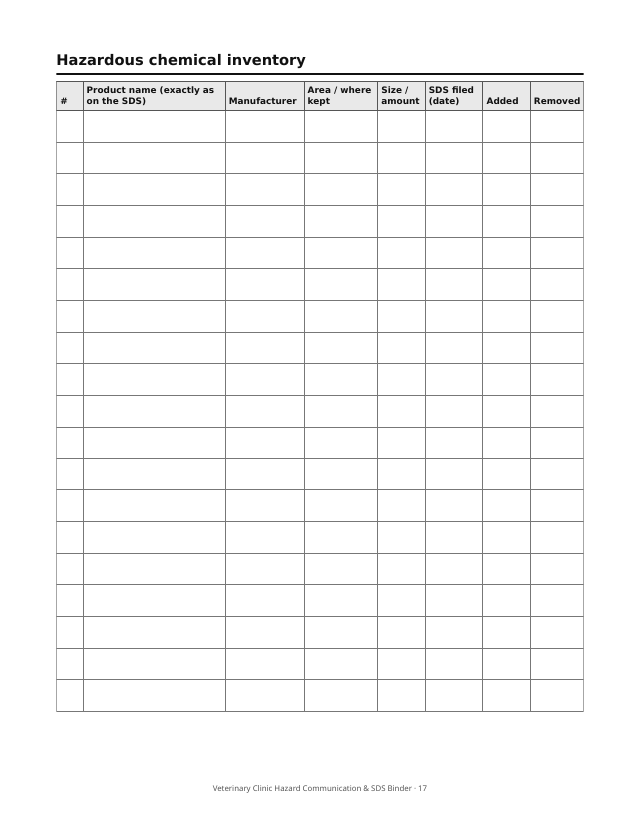
- pp. 15–34 · Hazardous chemical inventory. Ruled inventory pages for every product on site.
- pp. 35–46 · SDS index and revision log. Track which safety data sheet you hold for each product and when it was replaced.
- pp. 47–50 · Labels. Original versus secondary containers, how to make a workplace label, the GHS pictograms, and cut-out secondary-container label templates.
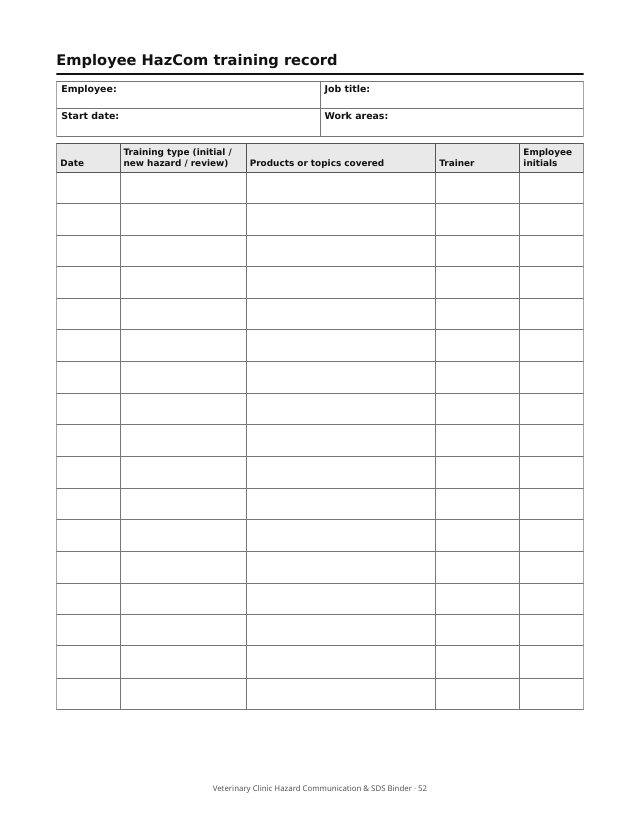
- pp. 51–70 · Employee training. What HazCom training must cover under 1910.1200(h)(2)–(3), an outline for a 30-minute team session, individual training records and group sign-in sheets.
- pp. 71–80 · New products, non-routine tasks, contractors. A new product approval log, non-routine task briefing forms and a contractor chemical information exchange form.
- pp. 81–89 · Annual review and reference. Four annual program review checklists with action lists, emergency contacts, chemical spill and exposure notes, a glossary, and a last page on keeping the SDS library current.
Updated for OSHA’s 2024 revision of the Hazard Communication Standard. Under 29 CFR 1910.1200(j), employers update workplace labels, the written program and training as necessary by November 20, 2026 for substances and by May 19, 2028 for mixtures.
Who it’s for
- Practice managers, clinic owners and the team member who runs the safety program at a veterinary clinic or animal hospital.
- Clinics that want their HazCom paperwork in one printed binder they can fill in by hand and show on request.
- Owners may photocopy the blank forms for use within their own clinic (stated on the copyright page).
What it is not
It is a set of fill-in templates and plain-English notes, not legal or compliance advice, and filling it in does not by itself make a workplace compliant. Waste anesthetic gases, ionizing radiation (29 CFR 1910.1096), formaldehyde monitoring (29 CFR 1910.1048), bloodborne pathogens, controlled substances (DEA) and hazardous-drug handling are separate programs; the book mentions them only as reminders. Hazard information for each product always comes from the manufacturer’s current safety data sheet.
How it was made: the text was drafted with AI assistance (Claude, by Anthropic) from SDSentry’s HazCom guides, with requirements cited to the paragraphs of 29 CFR 1910.1200.
Prefer to keep these records digitally? SDSentry, from the same author, keeps the SDS library, labels, written program and training records online; the free guide Veterinary Clinic SDS Binder: What to Include covers the same ground.