HazCom Program & SDS Binder for Small Businesses
HazCom Program & SDS Binder for Small Businesses is a 90-page, 8.5 x 11 inch paperback workbook of fill-in forms for keeping a small workplace’s OSHA Hazard Communication (29 CFR 1910.1200) records on paper: a written HazCom program template, chemical inventory pages, an SDS index and revision log, label templates, employee training records and annual review checklists. It costs $29.99 on Amazon (ASIN B0HP7F9NYY).
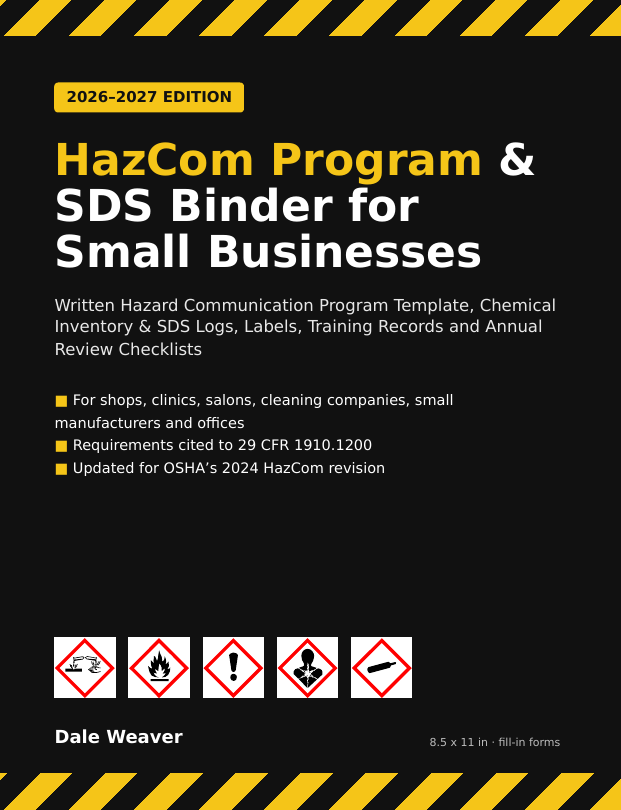
| Format | Paperback, 8.5 x 11 in, black-and-white interior |
|---|---|
| Pages | 90 |
| Price | $29.99 on Amazon.com |
| Author | Dale Weaver |
| Published | October 25, 2026 (independently published) |
| ISBN-13 | 979-8-165015571 |
| ASIN | B0HP7F9NYY |
What’s inside
- p. 4 · How to use this binder.
- pp. 5–8 · HazCom in a small workplace: what the standard requires. The employer requirements in plain English, which products usually do not need a safety data sheet, and what to do when crews work at other employers’ sites.
- pp. 9–12 · Written Hazard Communication Program (fill-in template). The written program with blanks for your business, cited to the paragraph of the standard each part comes from.
- pp. 13–15 · Chemical walk-through and program checklist. Walk every area, from the shop floor and storage room to vehicles, the break room and the janitorial closet, then tick off the program checklist.
- pp. 16–35 · Hazardous chemical inventory. Ruled inventory pages for every product on site.
- pp. 36–47 · SDS index and revision log. Track which safety data sheet you hold for each product and when it was replaced.
- pp. 48–51 · Labels. Original containers, secondary containers and the GHS pictograms, with cut-out secondary-container label templates.
- pp. 52–71 · Employee training. What training must cover, individual training records and group training sign-in sheets.
- pp. 72–81 · New products, non-routine tasks, contractors. A new product approval log, non-routine task briefings and a contractor information exchange form.
- pp. 82–90 · Annual review and reference. Annual program review checklists, emergency contacts and incident (spill) notes, and a glossary.
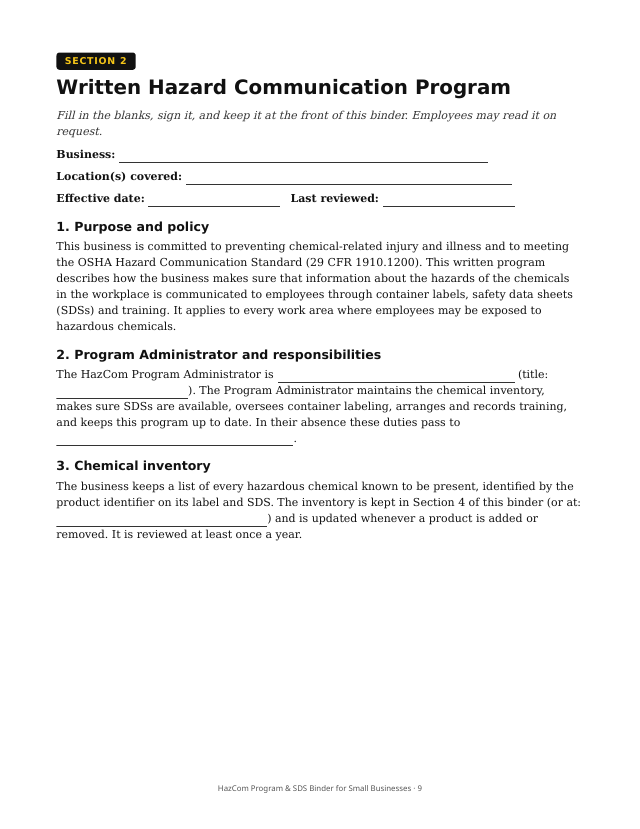
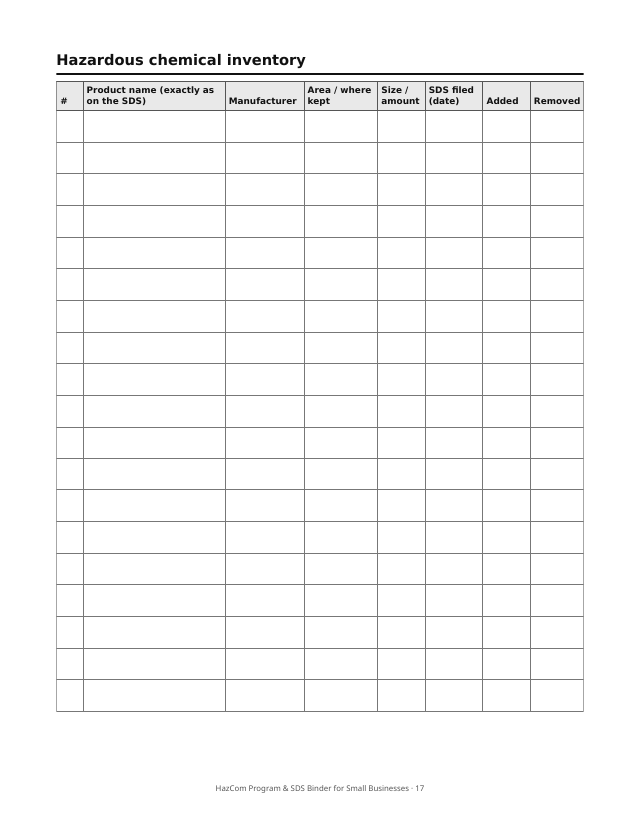
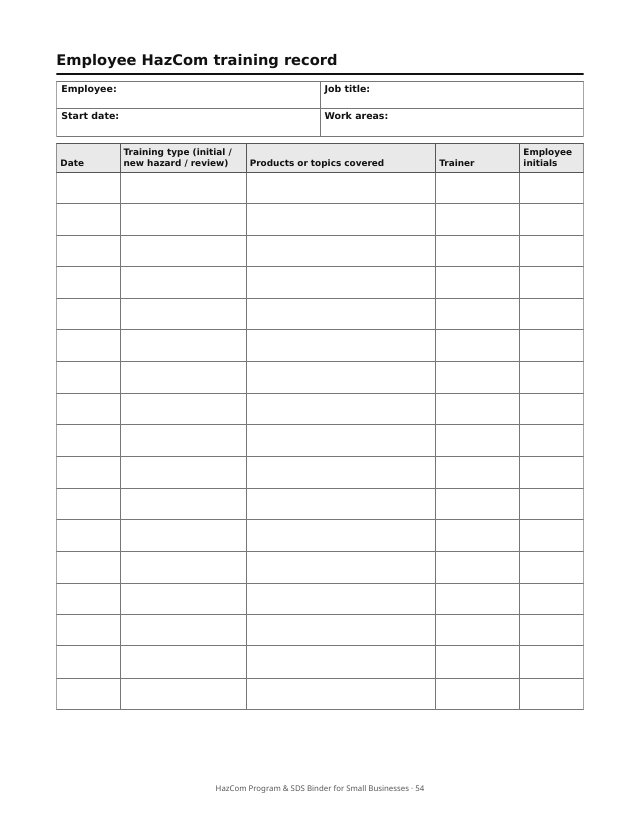
Updated for OSHA’s 2024 revision of the Hazard Communication Standard. Under 29 CFR 1910.1200(j), employers update workplace labels, the written program and training as necessary by November 20, 2026 for substances and by May 19, 2028 for mixtures.
Who it’s for
- Owners and managers of small workplaces that keep hazardous chemicals: shops, salons, cleaning companies, small manufacturers, clinics and offices.
- Businesses that want their HazCom paperwork in one printed binder they can fill in by hand and show on request.
- Owners may photocopy the blank forms for use within their own business (stated on the copyright page).
What it is not
It is a set of fill-in templates and plain-English notes, not legal or compliance advice, and filling it in does not by itself make a workplace compliant. PPE assessments, eyewash, respirators and flammable-liquid storage have their own OSHA rules; the book points to them but does not cover them. Hazard information for each product always comes from the manufacturer’s current safety data sheet.
How it was made: the text was drafted with AI assistance (Claude, by Anthropic) from SDSentry’s HazCom guides, with requirements cited to the paragraphs of 29 CFR 1910.1200.
Prefer to keep these records digitally? SDSentry, from the same author, keeps the SDS library, labels, written program and training records online; the free guide Written HazCom Program: What It Must Contain covers the same ground.